Ryedale Woodturners
This website is being updated from August 2022. This is an archive page.
DAVID LOWE
Thursday 6 November 2014
Snainton Woodturning Supplies
Dave stepped in at short notice in place of Mark Raby. He turned a balanced bowl, and an unbalanced bowl.
Balanced bowl

Dave started with a 9 x 2 inch clean sycamore blank and turned a standard, unassuming bowl. He apologised for the "boring bit", but personally I enjoy watching turners do the basics and talking about what they are doing and why. For example, Dave came across some chatter on the inside, explained that it came from a bevel rubbing cut, so did a fine cut without the bevel rubbing, which removed the chatter marks, and then took a fine bevel rubbing cut to regain the good finish.
The bowl was finished inside and out with Mylands cutting wax - midly abrasive, applied with 3 grades of Nyrex pads after sanding to 320 grit. Initially Dave intended to have a groove around the rim of the bowl, painted black, but the paint bled into the grain of the wood around the groove, and spoilt the clean finish, so Dave removed this and left it plain.

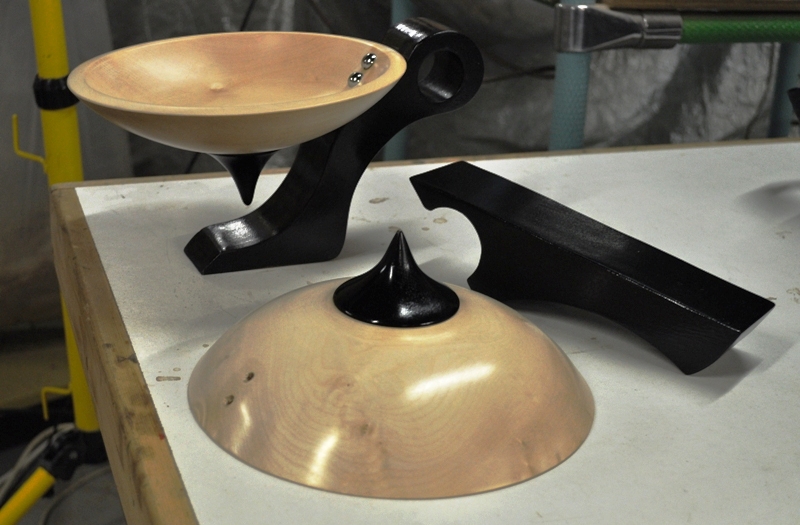
Once the bowl was turned, Dave started on a finial that would fit into the chucking recess. Turned between centres with a very shallow chucking point, the tailstock used to provide support for as long as possible. This finial was ebonised to match the balance stand.
 The stand had been made in advance as it was a cutting and shaping job rather than turning. It was ebonised. Two holes were drilled in the bowl, and chrome mirror plate screws were used to fix it to the balance stand. To finish properly, the base needed a little sanding at an angle in order that the bowl rested horizontally - but again not a job for a demonstration.
Unbalanced bowl
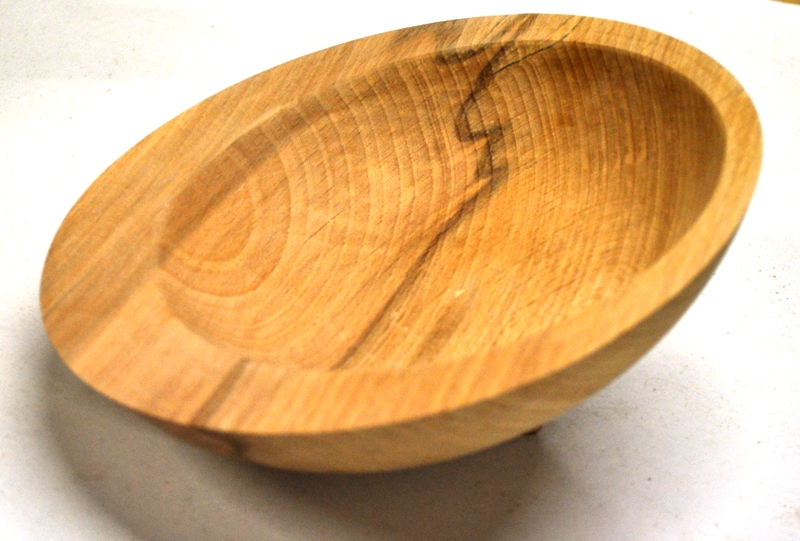
After the break the balance bowl was finished, and Dave had time for a second demonstration. He mounted a piece of spalted beech on the lathe and turned the back of a bowl, but with a large (in height) chucking spigot on it.
The piece was then reversed, and the large spigot was used to allow the bowl to be mounted with a significant wobble, whilst still being gripped tightly. The face was turned flat, and then a bowl dish was turned out. The result was an offcentre bowl with a wide and narrow rim. When the chucking point was removed (Dave suggested with an Arbortech and sanding disc) the bowl would stand with a sloping rim.

A very enjoyable demonstration of standard bowl turning, concentrating on techniques for a smooth finish, with the added interest gained by fixing the bowl to a stand. (Dave mentioned that he got the idea from a wine bottle holder that held the bottle horizontal by having its neck placed in a block of wood.) Only the most basic of tools used, and each move clearly explained.
Hints and tips
- Bowls often go slightly oval once hollowed, causing bumps and hollows which mean that sanding leaves a patch of raised grain (or 2). Dave recommends slowing the speed down for sanding, so that the abrasive is always in contact with the surface.
- To remove chatter marks, take a fine cut without the bevel rubbing, which should remove the marks, then take another fine cut with the bevel to get the desired finish.
- Using cutting wax after sanding to 320 or 400 provides a quick on-the-lathe finish with a good sheen.