Ryedale Woodturners
This website is being updated from August 2022. This is an archive page.

Ian Clarkson
Thursday 2 July 2015
Snainton Woodturning Supplies
Ian talked and demonstrated different techniques involved in bowl turning and hollow form, concentrating more on the techniques than on the finished product.
Oak thin walled bowl
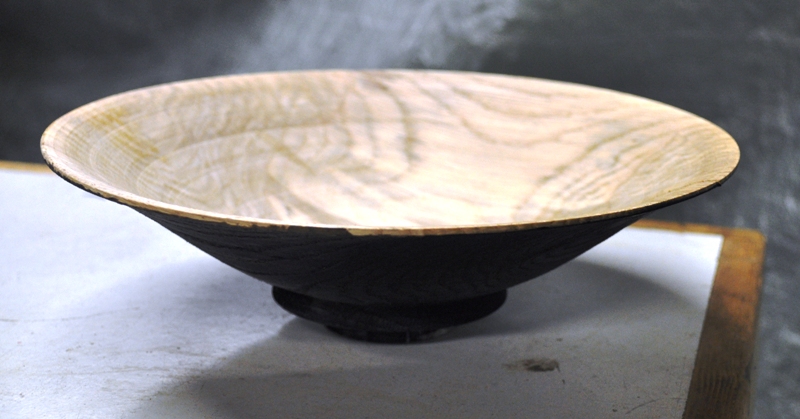
Ian started with a roughly cut blank, and turned it to a shape he was happy with. He explained he generally uses only 3 bowl gouges for his turning, plus a well-worn spindle gouge just for creating the dovetail on the spigot. Having rough turned quickly, he did then spend time refining the base and the foot to get it to his liking: referencing RIchard Raffan, he talked about how the curve should flow through the base, never out below it, and there should never be any hint of a straight line V-shape in the profile. The foot was turned with the spigot on top of it - the spigot was not the foot. Ian's suggested method for removing the spigot later was to use an angle grinder fitted with an arbortech wheel. He did not demonstrate this, perhaps in part due to Rob's protestations about how dangerous a tool an angle grinder is, especially without a guard. Ian ebonised the bottom by using a mixture of vinegar and wire wool, which certainly turned the wood black very quickly, reacting with the tannin in the oak.
The bowl was turned with quite thin walls, tested by finger and thumb and by calipers. No attempt to finish it was made before it was passed around for viewing. It did need finishing.
End grain bowl
The second piece turned was an end-grain bowl. Ian went through the relatively minor differences about turning such a bowl before handing the piece around. Be careful using centres which might split the wood, turn downhill with the grain. Cutting end-grapin blanks can sometimes make more out of a piece of timber. Frankly the end result was pretty grim - a horrible piece of dry timber, very roughly finished with little to commend it to the eye.
Hollow form

Ian takes down trees as well as turning, and inevitably comes across quite a lot of overgrown leylandii. He said it turns surprisingly well, and to prove the point embarked on a hollow form using the timber.
He left quite a large chunk at the headstock while hollowing, to give strength and support. The hollowing was started by driving his three bowl gouges in size succession into the centre of the piece, acting in effect as drillbits.
 With a centre hole to work out from, he then used two large hollowing tools. One was a cutter (a Big Brother), the other a scraper.
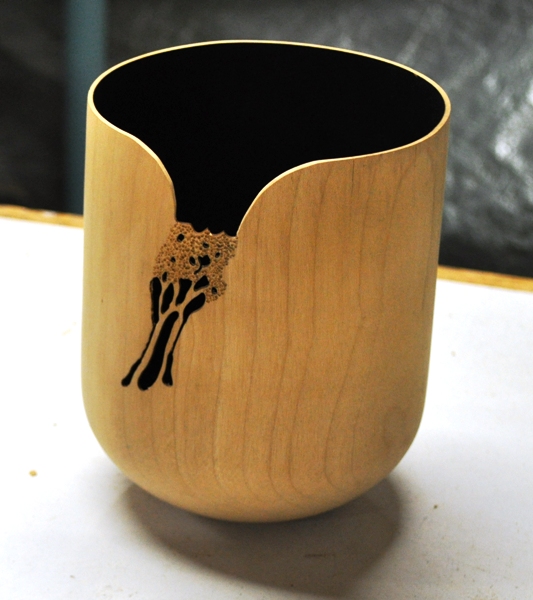
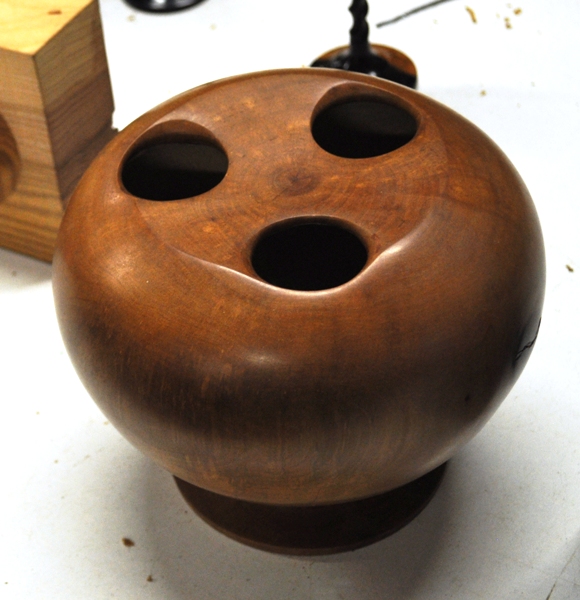 Ian brought a number of demonstration pieces along with him. A bowling ball shape turned and hollowed on three centres, three thin-stemmed goblets, a hollowed and pierced cup, painted black inside, a hollowed cube, a warped eucalyptus bowl, a rectangle with convex and concave shapes, and a stained leylandii bottle.
 Ian also filled the pauses whilst working with a selection of jokes. The cleanest of them involved an advert for a talking dog. A man responded to the advert, and the dog opened the door. "Good morning sir, how are you." The man could not believe his ears, and said so to the dog.
 "Oh yes sir, and I do more than talk. Last year I passed my A levels, wrote a book, and did open heart surgery on a man in the street".
The potential buyer was impressed, and spoke to the dog's owner. "Why do you want to sell such a talented dog?"
"Because I am fed up with his lying!"
 Other jokes are perhaps best not put into print here. The tale of the man going into the pub with a crocodile, the ventriloquist visiting the farmer, the golf match on Christmas Day and more I leave to your memories.
An interesting demonstration of techniques for bowl turning, without producing any finished work. Some techniques are to be pursued with caution!
Hints and tips
- When hollowing, to get the shavings from inside it is sometimes best to remove the chuck in order to turn the piece upside down. Don't remove the piece from the chuck - it won't centre true again.
- Very flat grinds on bowl gouges are good for cutting across the base of deeper bowls - 60 degrees or more.
- When rough turning wet wood for bowls, leave a stem in the centre to allow chucking in both directions.
- The inside of a hollow form can be painted matt black to good effect - blackboard paint will do - hiding any imperfections and taking the inside out of the overall view of the object.