Ryedale Woodturners
This website is being updated from August 2022. This is an archive page.

Richard Findley
Thursday 5 July 2018 7 - 9 pm
Snainton Village Hall
We welcomed Richard on a long journey up from Leicester, to give a demonstration of turning wood and pewter. A very warm evening, part of the continuing long hot, dry summer that was 2018.
Box with pewter inlay

Richard has been tackling a number of "things I've never done" for his articles in the Woodturning magazine. One of these was working with metal inlays, mainly pewter.
He started by turning a mould from a scrap piece of tulipwood. The pewter inlay would be a rivet-like piece, which would end up as a dome shaped button in the top of a box. The stem would be cut off - to be re-melted for another project.

To show how easy it is to melt pewter, Richard had brought a long a cheap camping stove (from Halfords), and an even cheaper saucepan (from Wilko). He put in some lead-free pewter blocks, and pewter shavings from a previous project.

The pewter melted within a few minutes, and was poured in to the mould to set. It was solid within another few minutes, but Richard used a previously made piece to allow the new one to set hard. It was tapped out of its mould via a hole through the base.

A small box was then turned from a block of sapele. There was plenty spare at the end, which would be used as a jam chuck to finish the base. The shape came from Turned Boxes, 50 designs, by Chris Stott. Richard admitted he was a production turner, not a designer, so looked for ideas from resource books.

The lid was parted off and turned first, held on a chucking point made on the end of the block. Richard took great care to get the inside of the lid absolutely square to the rim - crucial for a good friction fit. He used a ruler resting inside, and then looking down it by eye to check it was square.

Once he was happy with the lid, he then remounted the base and worked on the tricky bit - making the lip just the right size to fit snugly. Given time, he would allow the pieces to settle over a few weeks, then turn the lid, but this was a 2 hour demonstration.

He jammed the lid on to finish the top, then made tiny adjustments until the fit was just right. - it would hold if lifted, but was not too tigh. He then made a jam chuck out of the spare timber, jammed the bottom of the box on and finished the base.

The pewter insert was turned to shape and to fit. Scraping is better than cutting with pewter. It was then polished, with abrasive to 1200, then buffed (using a pewter-only mop) with Chestnut burnishing cream. The final result was a mirror-like finish.
Hints and tips
- Richard used a negative rake scraper for most of his scraping work. This included one made from a round bar skew. Its use means you can hold the chisel at an upward angle and it will still work: with a standard grind scraper you need to raise the rest to allow the chisel to point downwards.
- Putting a very small step on the join between the lid and base of the box - just defines the join, and hides any movement.
- The bottom part of a caliper is a depth gauge.
- Scraping pewter may cause chatter - which can be turned to advantage and used to created decorative effects.
- Search out lead free pewter. See the label below for one possible source.
- Epoxy glue works best for metal on wood fixing.
A few pictures of Richard Findley's exhibits

Box showing small step on join

Bowl with pewter rim

The finished box
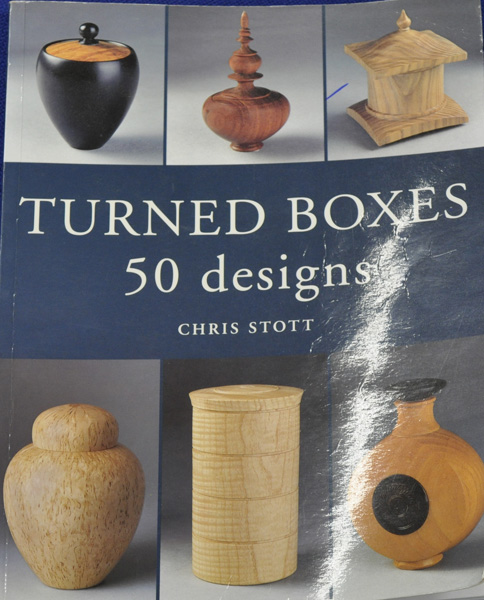
Chris Stott's box designs book

Some of Richard's work

A neat card holder

Boxes with pewter inserts

Pewter supplier label