Ryedale Woodturners
This website is being updated from August 2022. This is an archive page.

Steve Fearnley
Thursday 7 October 2021
Snainton Village Hall
Steve Fearnley stepped in at relatively short notice following a cancellation by a professional demonstrator. His subject was "pinch pots", together with a turned salt spoon. A video of most of the demonstration is available (the first part is missing, turning on recording was forgotten). There are no photos from the night as Steve usually takes these, and he couldn't do both jobs. The ones used here are taken from the video, and from Steve's oldfern website
Pinch pots
 Steve came across the idea of pinch pots for serving salt and pepper on a visit to the Yorkshire Sculpture Park, where there were some little turned wooden pots in the gift shop.
On a quest to use up some of the multitude of off-cuts and dismantled furniture that "might come in useful one day", he designed two small pots to turn from African Blackwood, sycamore and beech.

Because he was using offcuts, he first tried an offcut of sycamore that had the grain running across rather than along the blank. This didn't work: there were catches and when it came to hollowing out the bowl of the dish the thin edge broke.

After a little hesitation he decided to have another go with a true spindle blank, with the grain running along the turning axis, not across. The difference was marked, so in the end the early error showed the value of choosing correctly orientated grain. If only he had thought to say this was an intentional demonstration of grain problems!

The base for the pots was held in the chuck with two jaws removed, and some thin spacers jammed in to prevent the remaining two jaw teeth diggin in to the wood. Two recesses were cut into the base using two different centres. The base ws then held lengthwise between centres to turn the handle. Three bands were burnt into the handle using a peice of Formica to create friction (after grooves were created with a point tool). A brief explanation on how the writing would by pyrographed was offered but not demonstrated in full.

After the break Steve had a look at turning a salt spoon (or a pepper spoon, or a coffee spoon). He had seen the idea on a YouTube video by Ernie Conover, for Woodworker's Journal. The interesting part was how the spoon was held while the bowl was turned.
 A 12 inch diameter flat circle, made of chipboard (but it could be any scrap wood), was fixed to a faceplate and mounted on the lathe. A 4 inch length of square-section beech was stuck onto the plate using double sided tape. This is strong enough to hold the piece while the bowl of the spoon was hollowed out.

With the bowl turned, the blank was then mounted using a small chuck (Record RS 2000) to hold the square section of the blank in its jaws. The handle was turned, again with some decoration using the Formica strip bun technique. The spoon was sanded, parted off and the ends sanded round.

This can be a good way of using up small offcuts - these spoons were made from an old beech drawer front cut into what look like short pen blanks. It is important to try and get them square, so the walls of the bowl are an even thickness.
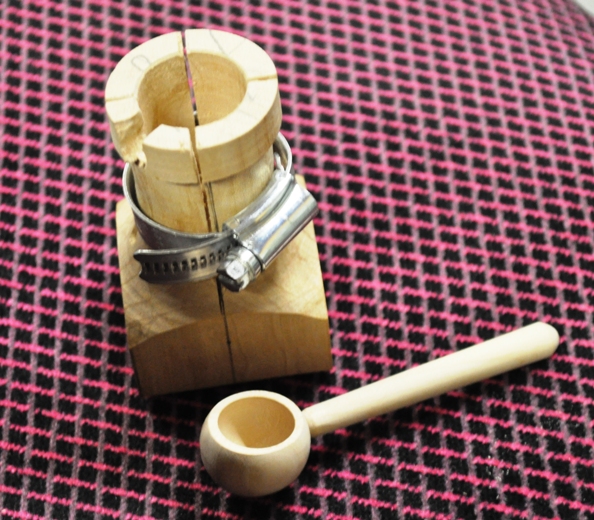
Margaret Garrard showed us an alternative method of holding a spoon back in October 2014 . This involved turning a small jig to hold the spoon. She turned the handle first, with a sphere at the end which was then hollowed in the jig. A more elegant solution perhaps, but the double sided tape does work.