Ryedale Woodturners
This website is being updated from August 2022. This is an archive page.

Martyn Weller
Thursday 5 August 2021
Snainton Village Hall
Martyn Weller presented our first demonstration for 15 months, as the Covid restrictions eased. As well as the live demonstration we also broadcast via Zoom to members who could not attend on the evening. A few teething problems with ZOom technology, but we think we can improve.
Segmented turning
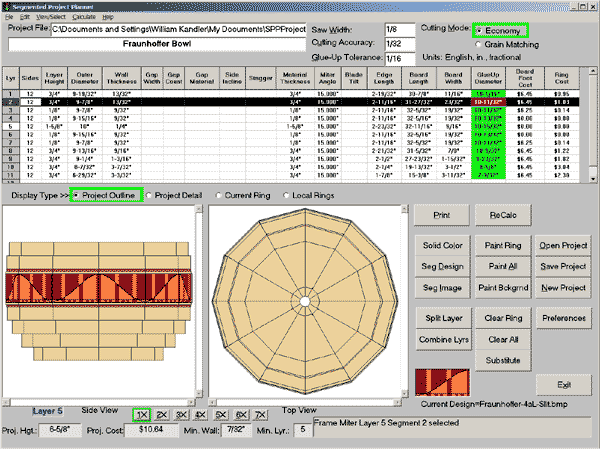 Martyn explained that the evening would not involve any turning on a lathe, instead he would take us through the various processes and stages involved in making a segmented blank, ready for turning. He explained a little of the maths at a simple level, and also showed us a Segmented Project Planner, and passed round a printed design he had produced for his latest project.

Not having a circular saw available on the night, Martyn had prepared a video showing how he cuts the individual pieces. (Apologies, I did not get a copy of the video to show here.) The required angle is set on a jig, which has an endstop to repeat the dimensions accurately for each piece.
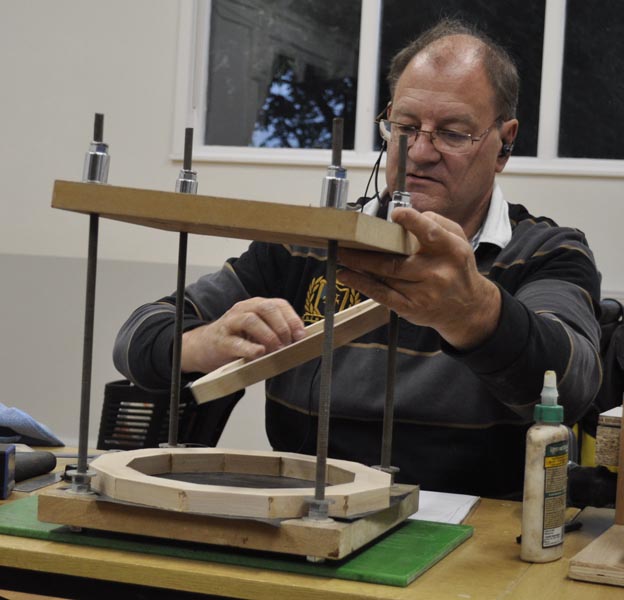
With a set of segments cut and lightly sanded to remove the burr, they are assembled in a ring and clamped with a large jubilee clip for gluing. These rings are then put in a press for gluing together. Using wing nuts on the rods can take forever to tighten, so Martyn had come up with a time saving device.
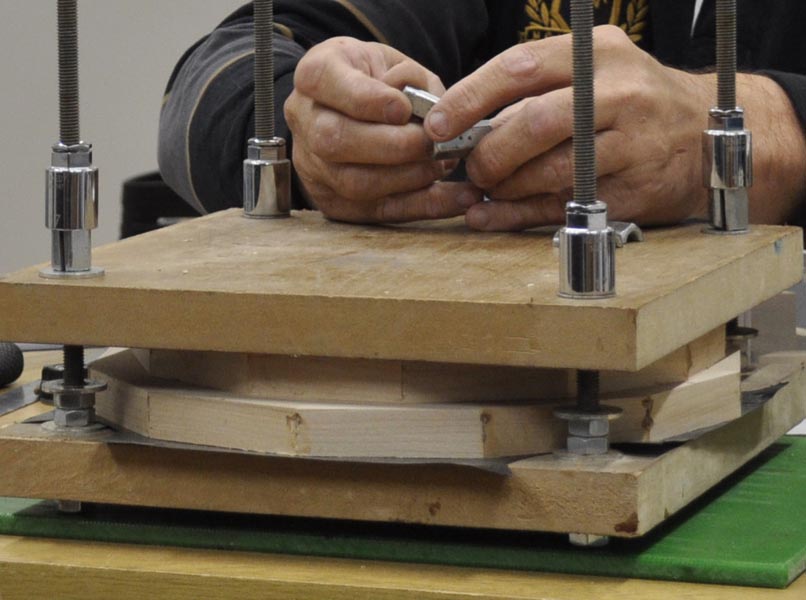
This involves four nuts sawn in half, which assemble at the bottom of the rods and fit into sockets, which can then be tightened with the nut above them, taking a few seconds rather than minutes. This provides a neat solution.

With a number of rings assembled, turning can begin. An mdf base is attached with hot-melt glue to hold the piece on the lathe. This can removed when necessary with heat from a hair dryer.
With the inside hollowed out, a plywood cone is attached to the tailstock and brought up inside the piece to give it strength while the outside is turned.

The piece that Martyn is working on is a large vase, and the temporary mdf base will eventually be replaced by a segmented base (of course!) This is assembled separately and mounted on its own temporary base for turning.

Each ring is glued together while being held in a jubilee clip, which holds the pieces well until the glue is set. The clip is simply screwed tight, then the ring tapped lightly to get it flat.

The middle section of the vase is to have a star pattern around it. Once dimensions are all worked out, each individual star block needs constructing, ready to be formed into a ring.
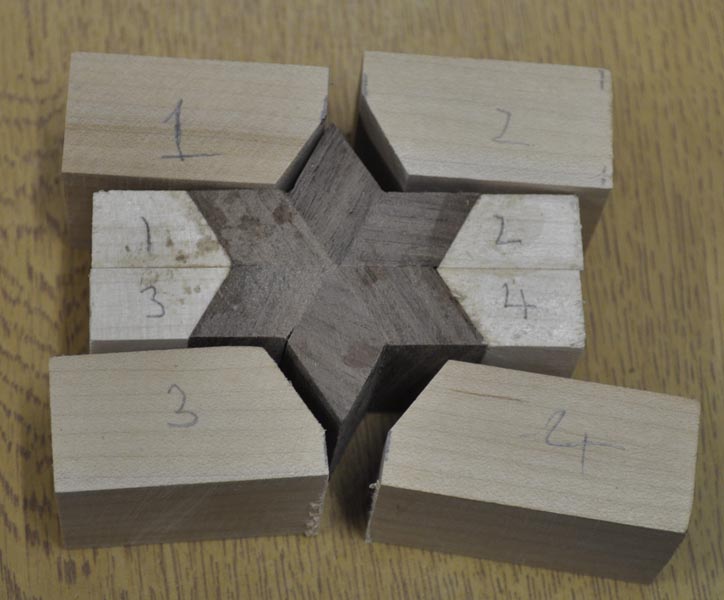
One star is made up of six diamonds, and this is then surrounded by 8 blocks to make up one rectangular section. Twelve of these rectangles will then go together to make the ring. Each needs cutting at an angle to form the ring (a dodecagon).
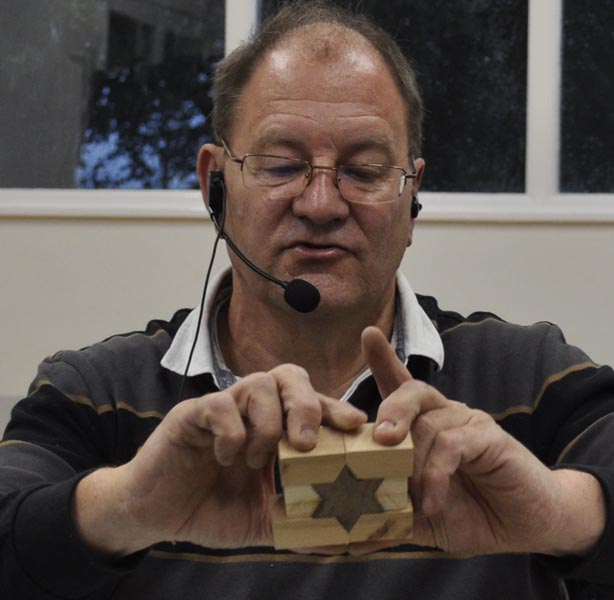 As well as jigs to cut pieces on the circular saw, Martyn had made a customised disc sander with a jig that allows him to sand small pieces such as these down to the required size, at the required angle. A high degree of accuracy is possible with this jig.
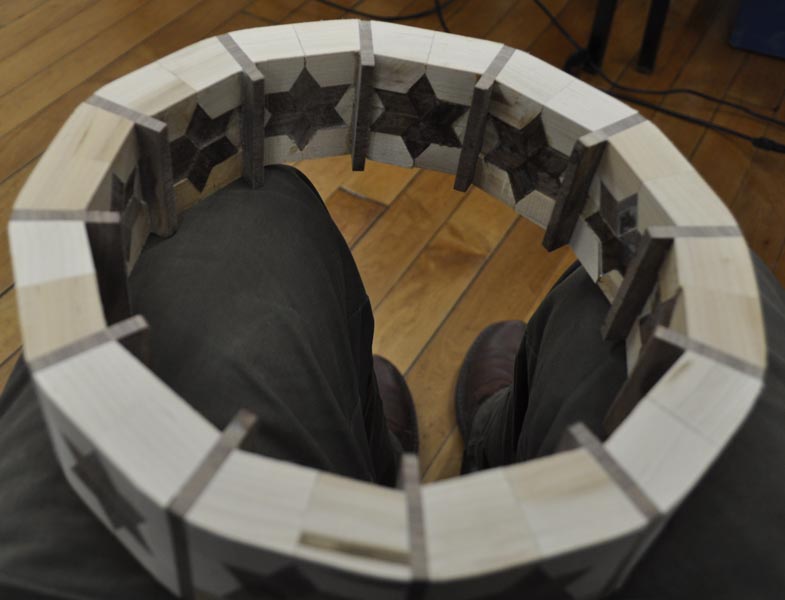
Another home made piece of equipment is a drum sander, which allows Martyn to put the rings through and get a perfectly flat ring of uniform thickness. Again he produced a short video for us to show this in action.
The star blocks were all clamped together and glued, with thin spacers between each one just to add a little more interest. Martyn then showed us the other rings that he had made, some very thin at less than a centimetre, to be used as bands to delineate the larger sections. I reckon there are twenty different rings involved here.

In response to a question from the audience, Martyn said there were over a thousand individual pieces involved in constructing this vase. And in response to the inevitable "how long does it take?\", probably well over 50 hours. I suspect this is a conservative estimate, and certainly doesn't include the hours spent making bespoke machinery and jigs to solve problems.
A very different demonstration to start us off again after our long absence, and a very enjoyable presentation of a specialised woodturning discipline.
Some items were brought along for display - John Kershaw's miniature Windsor chair, Brian Wrigglesworth's spirals and other intricate creations, John Whiteley's off centre turning, eccentric chuck, doughnut chuck and centre steady, Steve Fearnley's pyrography competition piece and offcut turnings, and some bowls turned by a young guest visitor, Jack, who lowered the average age of the meeting considerably. Some photos are below.
Some of the items on display on the evening

Homemade centre steady

An icosahedral (20 sided) piece

Items on display- John Kershaw's miniature windsor chair, pieces by Brian Wrigglesworth, and a bowl by ?
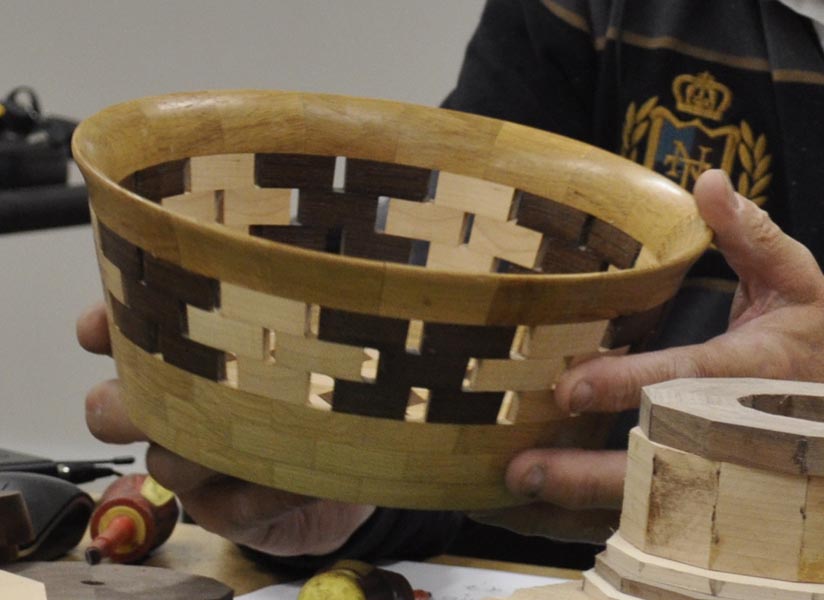
Open segmented bowl

Off centre items turned by John Whiteley
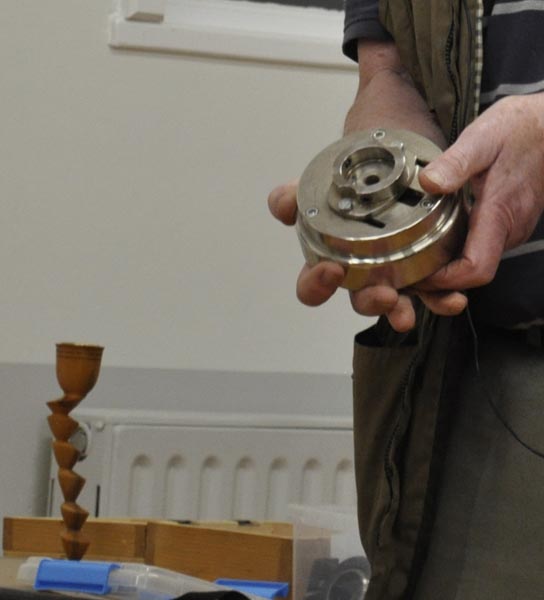
Eccentric chuck belonging to John Whiteley, but available on loan for anyone who wants to "try something different". M33 thread.

Martyn Weller's segmented turning exhibits