×
![]()
Ryedale Woodturners
John Whiteley
Thursday 2 March 2023
Snainton Village Hall
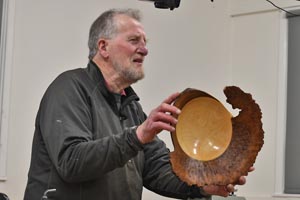
Club chairman John Whiteley gave a demonstration looking at how to deal with "difficult" wood, bringing along a few examples, turning a short silver birch log, and tackling an awkwardly shaped burr during the evening.
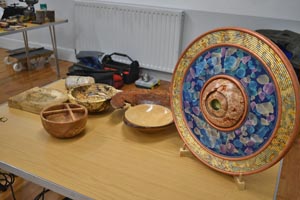
He showed an example of using two different timbers to make use of an interesting burr that didn't have enough on it to make a bowl. Also a square oak burr where some texturing saved more of the burr than just turning a round bowl.

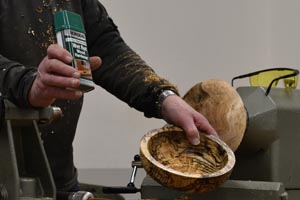
Spalted wood can go a little too far in its spalting - it "loses its nature" as Rob Thompson used to say. John showed us a piece of heavily spalted "punky" field maple, which needed a good soaking with thin, cheap, CA glue to harden it first. Proprietary wood hardener can also be used, such as Wet Rot Wood Hardener by Ronseal.
As a starter, a small silver birch log was mounted on a nylon chuck screwed into the log with plenty of screws. John finds this a strong method of attaching irregular shapes. The nylon chucks are cut out of chopping boards than can be bought for a few pounds, and will make half a dozen dovetailed discs that can be held in a standard chuck.

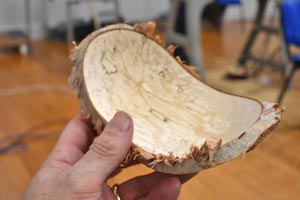
A foot was turned, and a profile created. The log was then reversed and hollowed out to created a banana boat shape. Difficult to sand whilst spinning, this would be finished by hand sanding, which was not attempted on the night. John had a sack of similar logs for people to take away and have a go. He looks forward to seeing the results at the next meeting.
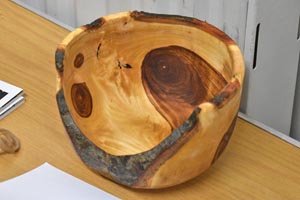
For the main course, John served up an interesting burr elm block, with an irregular shape in the burr. Again he mounted this on a nylon chuck with plenty of screws, and began to turn away the burr, looking for enough flat area to create a foot. Very rough aggressive turning, quite a lot needed to be sacrificed to find the flat: a foot doesn't need to be a perfect complete circle, but it does need to be solid wood. John opted for a much smaller foot than would normally suit a bowl of this size, in order to retain more of the burr.


The bowl was hollowed out gradually, leaving a core in the centre to provide some stability while the edges were shaped. As this progressed one area became very thin and eventually broke through to create the desirable hole. The whole bowl was turned up to this point using a bowl gouge.
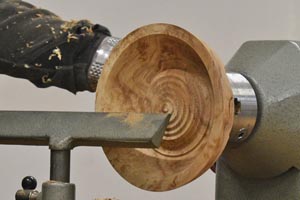

Final shaping went carefully, not turned too thin, though John might have gone a little further had he been at home in his own workshop without 50 people watching him. He used a scraper in the final stages, though only on the solid areas - a catch could crack the whole bowl in its relatively fragile state.
There was not enough time left after the bowl to make any boxes, but John had brought along a selection of boxes he had made over a couple of days. Making boxes allows for a variety of form and design, where subtle differences can make a significant change to the overall look and feel of a box.
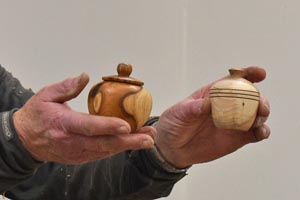

Sometimes it is well worth while making a batch of similar items, then stepping back to look at what works well, and what is less effective, and thinking about why, making honest judgements about the pieces made.